Lower carbon, better buildings
REX makes insulated panels and profiles for industrial buildings, engineered to cut a building’s energy demand from day one. As part of Recticel Group, our sites fall within the Group’s science-based climate targets, externally validated and publicly reported.
What the panel does for your building
-
Lower energy demand
High thermal performance minimises heat loss, reducing both operational cost and the carbon footprint of the building in use; the largest part of its lifetime emissions.
-
Airtight
Air and water tightness are built into the panel and its joints, so the envelope performs as designed instead of losing energy through gaps.
-
Less waste
Every panel is produced to project length as a single factory-manufactured unit. Cutting happens in the factory, not on site, which cuts offcuts, deliveries and packaging.
-
Less steel
Self-supporting spans of up to 10 metres combine structural strength with low weight, reducing the supporting steel a building needs and the embodied carbon that comes with it.
-
Right-sized
PIR or mineral wool, in a range of thicknesses and finishes, so the envelope is specified to what the project actually requires rather than over-specified — no material used that the building does not need.
Materials and circularity
REX panels are built around two core materials: PIR and mineral wool. Mineral wool panels are recyclable up to 98%.
Proof for your specification
Sustainability has to be demonstrable in a tender file. Declarations of Performance, Environmental Product Declarations (EPD) and certificates are available in our bookshelf.
The same targets as the Group
Recticel Group has committed to reducing its absolute Scope 1 and 2 greenhouse gas emissions by 90% and its absolute Scope 3 emissions by 25%, both against a 2021 baseline, on its pathway to achieving net-zero emissions by 2050. These science-based targets were validated by the Science Based Targets initiative (SBTi) in February 2024 and fully encompass REX operations.
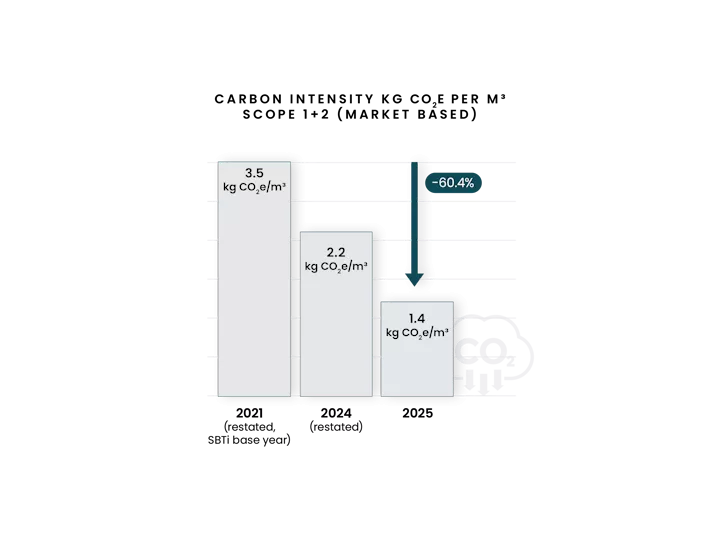
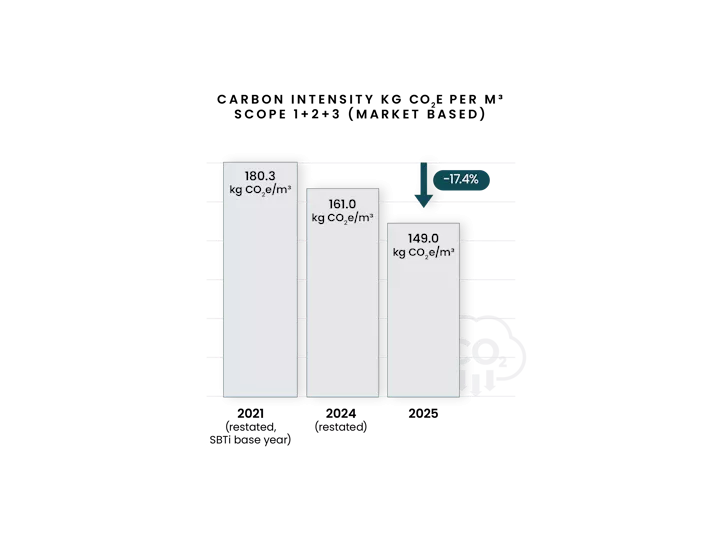
As of year-end 2025, Recticel Group had reduced its Scope 1 and 2 greenhouse gas emissions intensity per cubic metre produced by 60.4% compared with 2021, while lowering its combined Scope 1, 2 and 3 emissions intensity by 17.4%.
The building insulation products sold by Recticel Group in 2025 are expected to prevent approximately 20 million tonnes of CO₂e emissions over their lifetime. This represents a positive climate impact approximately 33 times greater than the Group’s own annual carbon footprint, underscoring the critical role of insulation in the decarbonisation of buildings.
The same targets as the Group
Recticel Group has committed to reducing its absolute Scope 1 and 2 greenhouse gas emissions by 90% and its absolute Scope 3 emissions by 25%, both against a 2021 baseline, on its pathway to achieving net-zero emissions by 2050. These science-based targets were validated by the Science Based Targets initiative (SBTi) in February 2024 and fully encompass REX operations.
As of year-end 2025, Recticel Group had reduced its Scope 1 and 2 greenhouse gas emissions intensity per cubic metre produced by 60.4% compared with 2021, while lowering its combined Scope 1, 2 and 3 emissions intensity by 17.4%.
The building insulation products sold by Recticel Group in 2025 are expected to prevent approximately 20 million tonnes of CO₂e emissions over their lifetime. This represents a positive climate impact approximately 33 times greater than the Group’s own annual carbon footprint, underscoring the critical role of insulation in the decarbonisation of buildings.